How to Start Investing With Little Money: A Beginner’s Guide
You’ve heard it before: “You need to start investing.” But what does that actually mean when you’re still figuring out your budget, paying off debt, or just trying to keep up with the cost of living?
If you’ve ever wondered how to start investing with little money as a beginner, you’re not alone. Most people were never taught how investing actually works.
Here’s what I want you to know from the start: investing isn’t just for people who already have money. It’s actually one of the most powerful tools for people who are building it.
I grew up watching my family work incredibly hard – and still struggle financially. Not because they didn’t earn enough, but because no one ever explained how money could grow on its own. That’s what investing does. And the earlier you start, even with just a few dollars, the more it works in your favor.
This post is your starting point. No jargon, no shame, and no assumption that you already know what a brokerage is.
First: Why Bother Investing at All?
Saving money is essential, but saving alone won’t build wealth. Here’s why:
Inflation quietly erodes the value of money sitting in a regular savings account. What $1,000 buys today will cost more in 10 years. Investing is how you stay ahead of that curve.
When you invest, your money earns returns. Those returns then earn returns of their own. This is called compound growth, and it’s the closest thing to a financial superpower that exists.
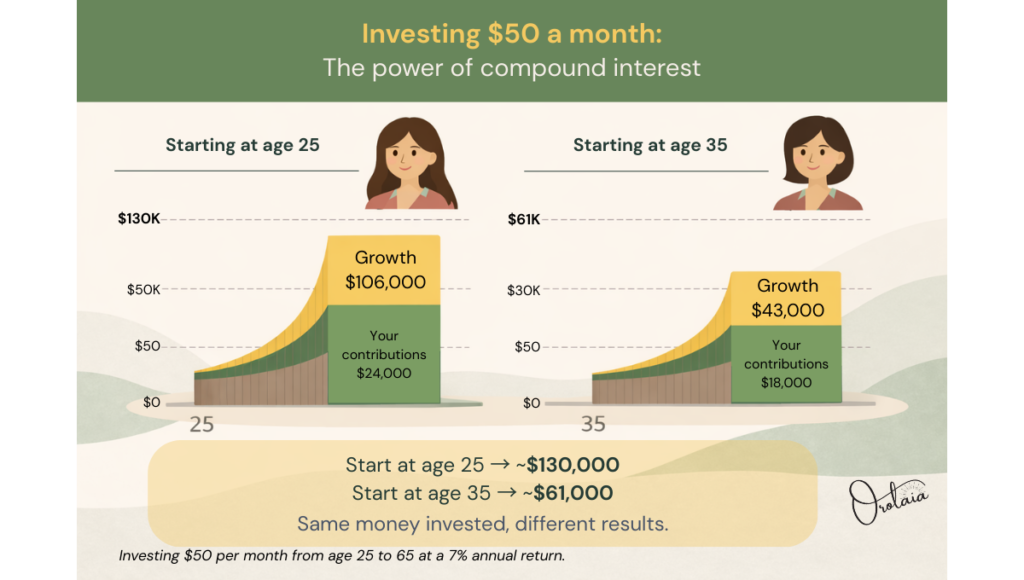
A simple example: If you invest $50 a month starting at age 25, and your investments grow at an average of 7% per year, by age 65 you’d have roughly $130,000 — from just $24,000 of your own money. The rest is growth.
Wait until 35 to start that same habit? You’d end up with about $61,000. Same effort, half the result.
Time is the ingredient you can’t buy back. Starting small today beats waiting to start big.
What Does “Investing” Actually Mean?
At its core, investing means putting your money into something with the expectation that it will grow over time.
The most common way people invest is through the stock market — buying small pieces of companies (called shares or stocks) or funds that hold many companies at once.
You don’t need to pick individual stocks or follow the market daily. Most beginners — and honestly, most experienced investors — do best with simple, low-cost index funds that track the overall stock market.
Do You Need a Lot of Money to Start Investing?
No. This is one of the biggest myths that keeps people — especially in our community — on the sidelines.
Many people assume you need thousands of dollars to start investing. In reality, you can begin with as little as $1–$5 thanks to fractional shares.
Many investment accounts today have:
- No minimum balance to open
- No minimum to start investing (some let you buy fractional shares for as little as $1 or $5)
- No monthly fees
The barrier to entry has never been lower. What you need isn’t a large sum of money — it’s the right account and a consistent investing habit.
Where Does Your Money Actually Go? Understanding Investment Accounts
Before you invest a single dollar, you need to open the right kind of account. Think of an investment account like a container — the account holds your investments the way a wallet holds your cash.
There are two main types of accounts beginners should know about:
1. Retirement Accounts (Tax-Advantaged)
These accounts are designed specifically for long-term investing — typically for retirement. The government gives you tax benefits to encourage you to use them.
The most important one for most beginners is the Roth IRA. A Roth IRA is one of the most powerful investing tools available because your investments can grow completely tax-free over time.
- You contribute money you’ve already paid taxes on
- Your money grows tax-free
- You pay no taxes when you withdraw in retirement
- You can open one with $0 at Fidelity, Schwab, or Vanguard
- 2026 contribution limit: $7,500/year (about $625/month) — or $8,600 if you’re 50 or older
We dedicate an entire post to the Roth IRA — including a step-by-step guide to opening one — right here: What Is a Roth IRA and Why Every Latina Should Have One →
2. Taxable Brokerage Accounts
A taxable brokerage account is a standard investment account with no special tax benefits — but also no restrictions on when or how you can access your money.
This is a great option if:
- You’ve already maxed out your Roth IRA for the year
- You want to invest money you might need before retirement
- You want more flexibility
Top brokerages for beginners (all $0 minimums):
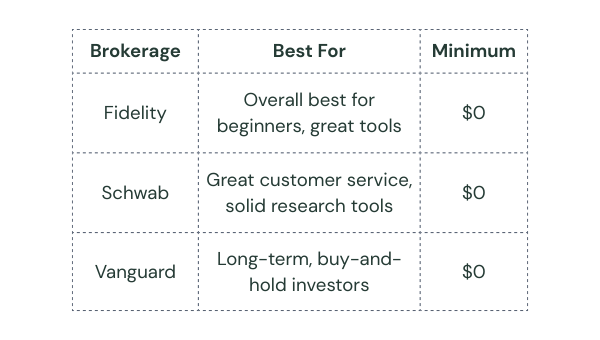
All three are well-established, trustworthy, and beginner-friendly. You can open both a Roth IRA and a taxable brokerage account at the same institution.
Once your account is open, the next step is simply to start contributing — even if the amount feels small.
The honest answer is: start with whatever you can do consistently. $10 a week. $25 a month. The amount matters less than the habit.
What Order Should You Invest In?
If you’re just starting out, here’s a simple order of operations:
Step 1: Build your emergency fund first. Before you invest, make sure you have at least $500–$1,000 set aside in a high-yield savings account for emergencies. Investing money you might need in three months is a recipe for stress. (Don’t have one yet? Read our guide: How to Build an Emergency Fund →)
Step 2: Open and contribute to a Roth IRA. This is your highest-priority investment account. Start here, even if you can only contribute $5 or $25 a month.
Step 3: Open a taxable brokerage account. Once you’re consistently contributing to your Roth IRA, a brokerage account gives you additional investing flexibility.
A Note on Investment Risk
Investing always involves some level of risk — the value of your investments can go up and down. This is normal.
What protects you from short-term volatility is time. The longer your money stays invested, the more it tends to grow, even through market dips. This is why starting early — even with small amounts — matters so much.
This content is for educational purposes only and not financial advice. Always do your own research and consult a licensed financial professional for guidance specific to your situation.
You’re Ready for the Next Step
Now that you understand the basics — why to invest, what accounts exist, and how little you need to start — it’s time to go deeper.
Next in this series:
- 👉What Is a Roth IRA – How It Works and Why It’s One of the Most Powerful Investing Accounts →
- 👉How to Invest Inside Your Roth IRA — Starting With Just $5 → (Coming soon)
Ready to clean up your credit foundation before you invest? Grab the free Credit Clarity Checklist →